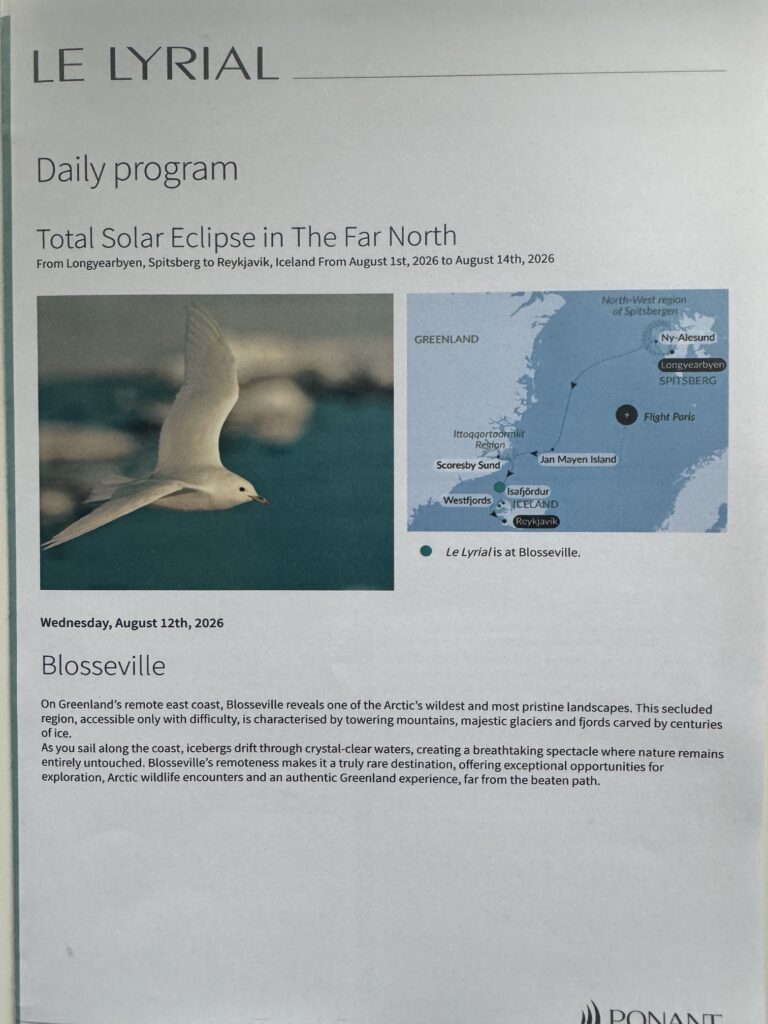
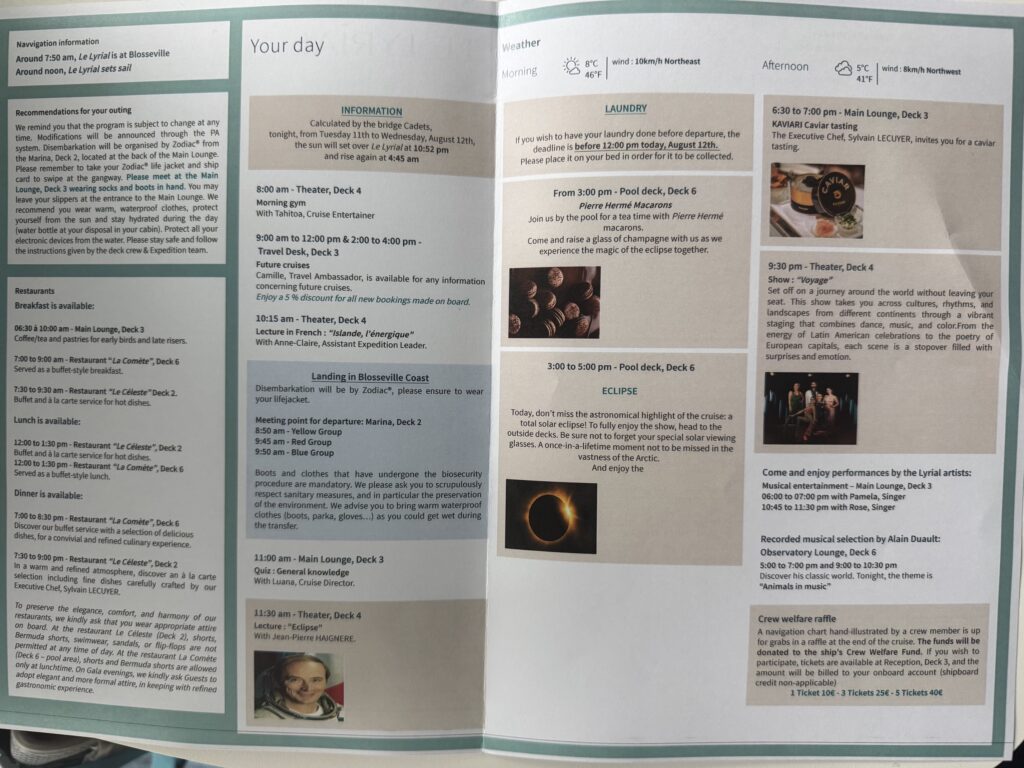
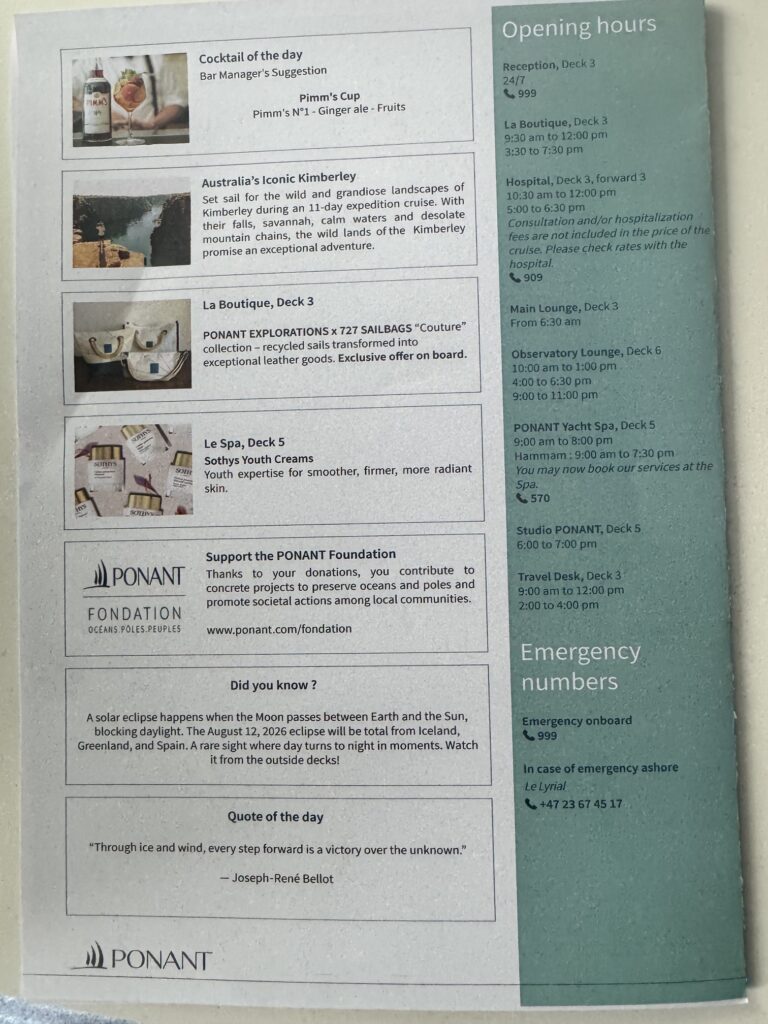
Today’s Daily Program:
The wildlife are kinder to us this morning – they wait til we’re awake and fed before we get the call informing us that there are sperm whales off the bow.
Fortunately, I brought my long lens with me. Unfortunately, I did not bring my coat. So my hands aren’t quite as steady as they should be when I finally get some shots:
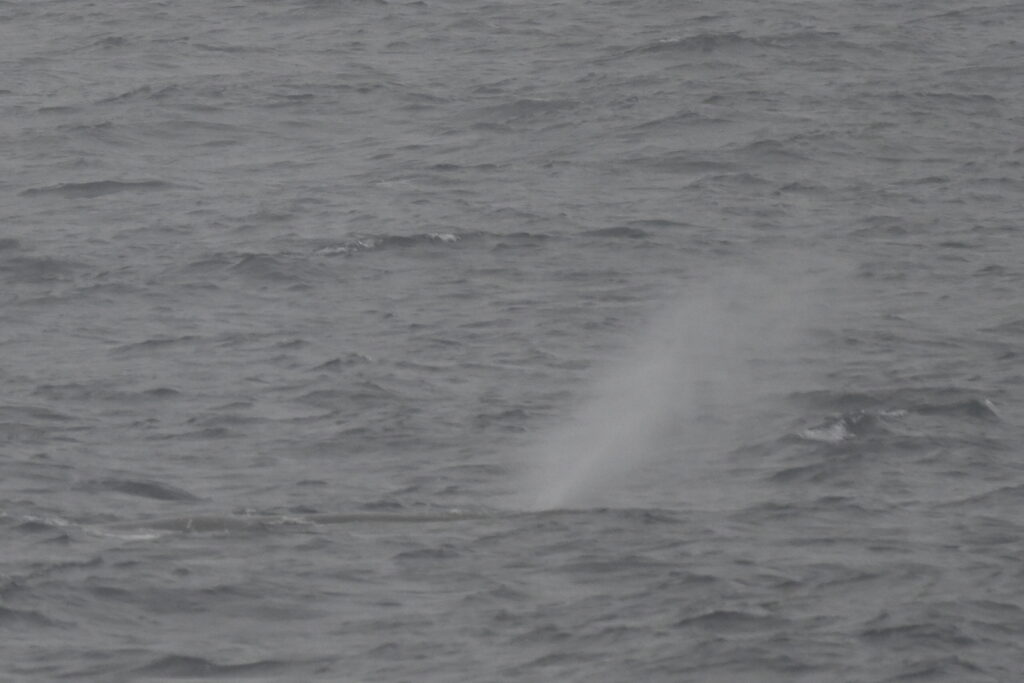
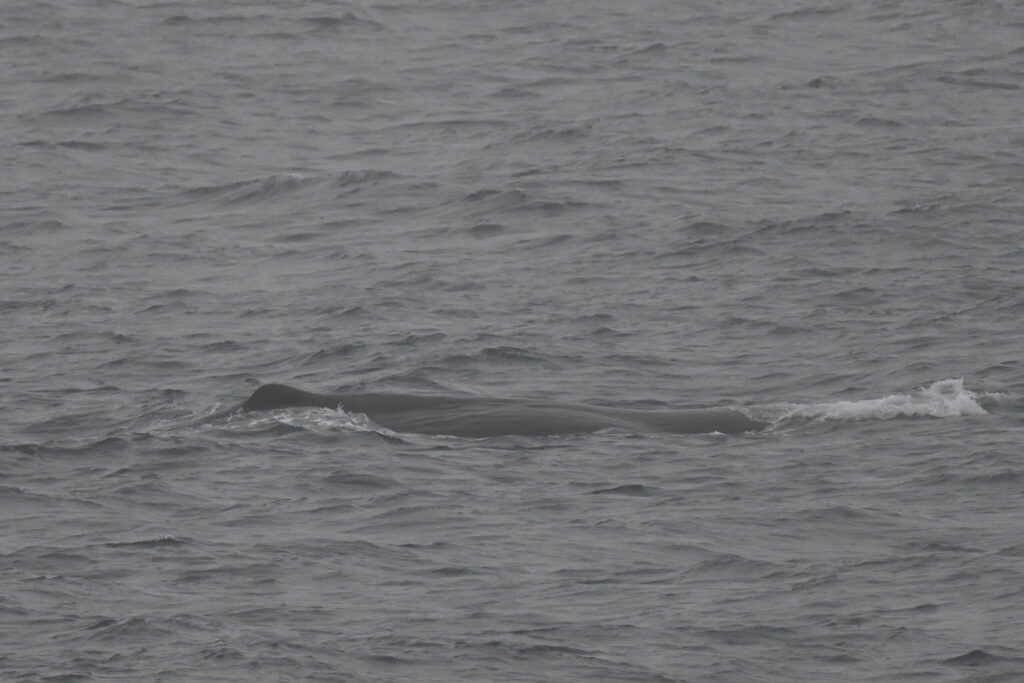

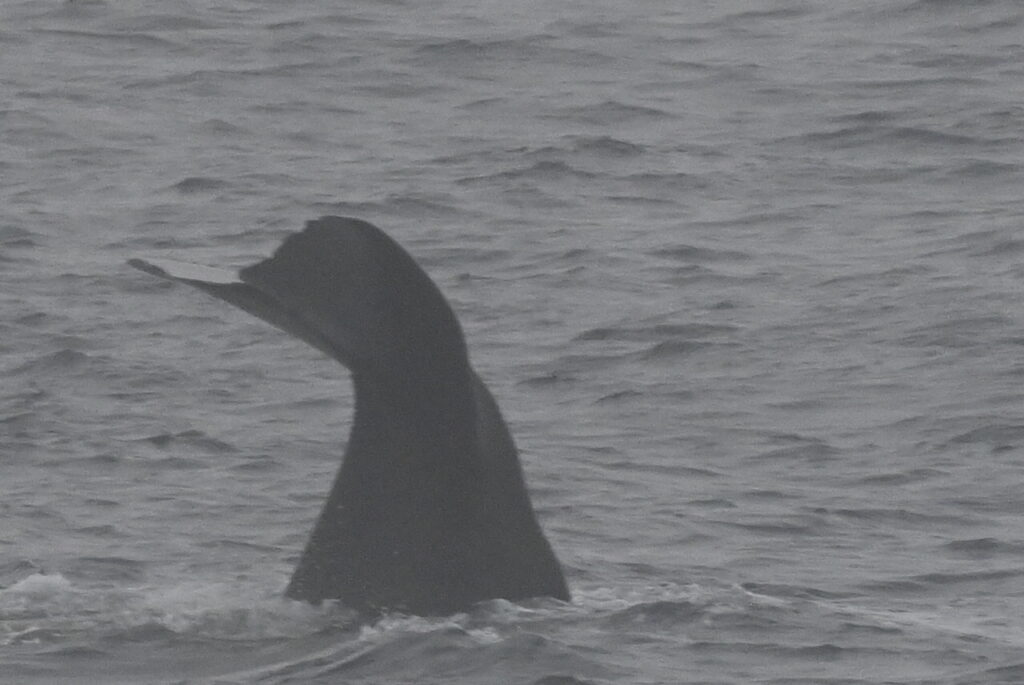
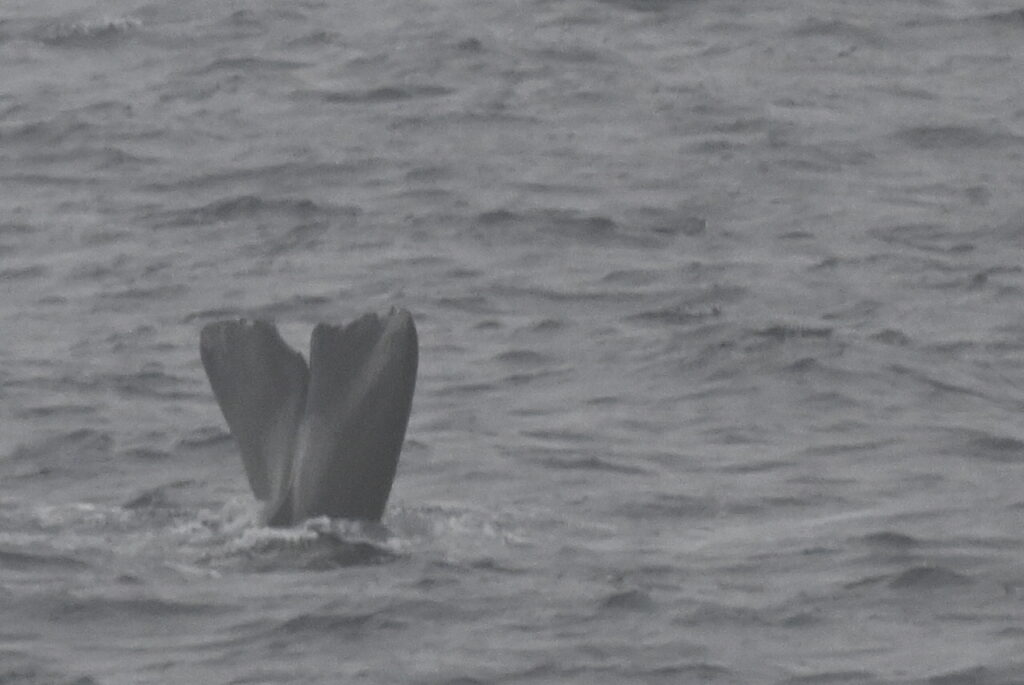
And – in what may prove to be foreshadowing – our planned morning expedition activity at Blosseville has already been cancelled due to fog.
From here, we begin the slow, steady trek to what the captain believes will be the only clear window of sky from Greenland to Iceland. It’s eclipse day today, though the entire quest feels vaguely quixotic. ‘Like finding a needle in a haystack’ could be restated as ‘Like finding an eclipse in the North Atlantic’.
However, we booked this cruise before it was rebranded as an eclipse cruise, so this aspect of the trip was never that important to us – but we won’t say no to an attempt, either.
From here, we head to French astronaut Jean-Pierre Haigneré’s lecture on the solar eclipse:
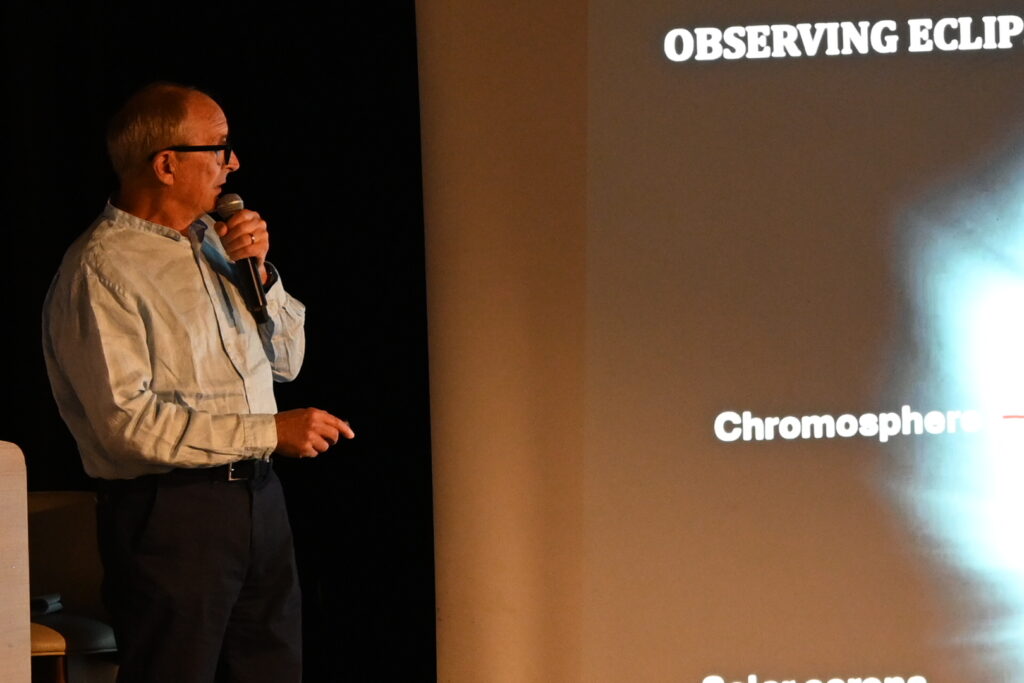
It gets off to a bit of a slow start. There are technical difficulties with either the projector itself or the translation system, and so there are continuous starts and stops. But eventually M. Haigneré hits his stride. He starts with historic perspectives on total eclipses, noting that they were important events in many cultures. However, it’s fascinating to learn that while many cultures – such as the Aztecs – reacted with terror, others – like medieval Islamic cultures – responded with intense curiosity.
He also notes that a French-led international team once undertook a flight in the Concorde 001 prototype with the goal of staying in totality as long as possible – flying faster than Mach 2, they managed to keep pace for 74 minutes. Mauritania actually closed its airspace to ensure the success of the Concorde flight, and the Concorde managed to intercept the totality within one second of the planned timeline. Multiple scientific experiments were conducted during this period, including measuring the effect of the eclipse on oxygen atoms through a side-porthole.
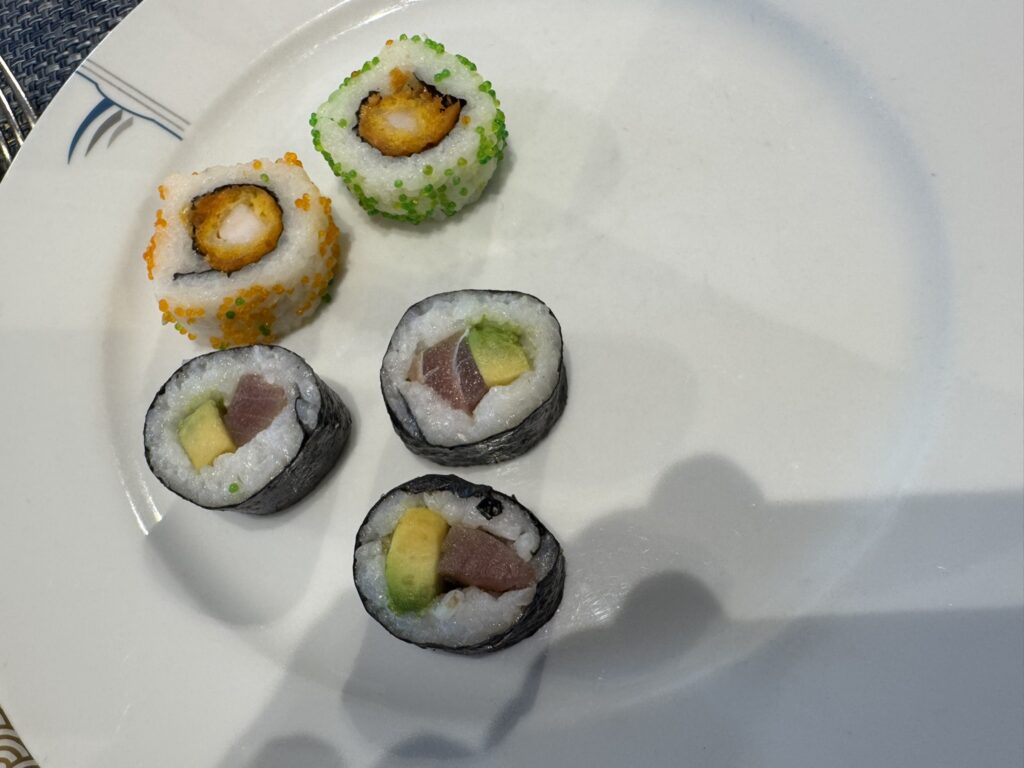
Off for lunch – they’re serving some lovely sushi today:
We take a bit of time to read / write / relax, and I take some time to review the eclipse photography how-to video from Hudson Henry. Cliff notes, for those inclined, are to use a fixed setting and a solar filter during the partial eclipse but then to take shots using exposure bracketing – and without the filter – during totality. I take some time to dial in my settings and save them to the camera so that I can pull them up quickly when (if) the moment arrives.
We then head up to Observation – which is already packed.
We’re heading west-northwest at a leisurely pace when suddenly the vessel turns and we pick up speed. Not a good sign. The captain comes on over the ship’s speaker to inform us that our initial window of clear sky has closed, but that there is another window opening up which we will attempt to reach. And we apparently won’t spare the horses.
We are also warned against venturing out at the bow of the vessel, as the wind is exceeding 50 knots.
I venture downstairs to gather up all of my gear, and there’s a brief moment of panic as I can’t find the portion of the tripod that connects the tripod itself to the camera. (A rather critical piece, all considered.) I eventually manage to track down the missing piece in my backpack and head upstairs to the pool area, where champagne and macarons are being served beneath an ashen sky.
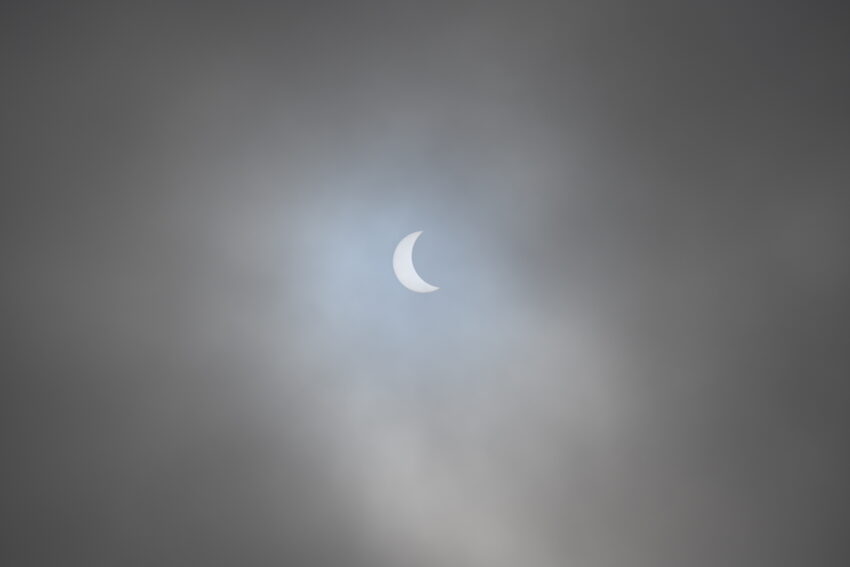
But to my surprise, we actually manage to catch a break in the clouds:
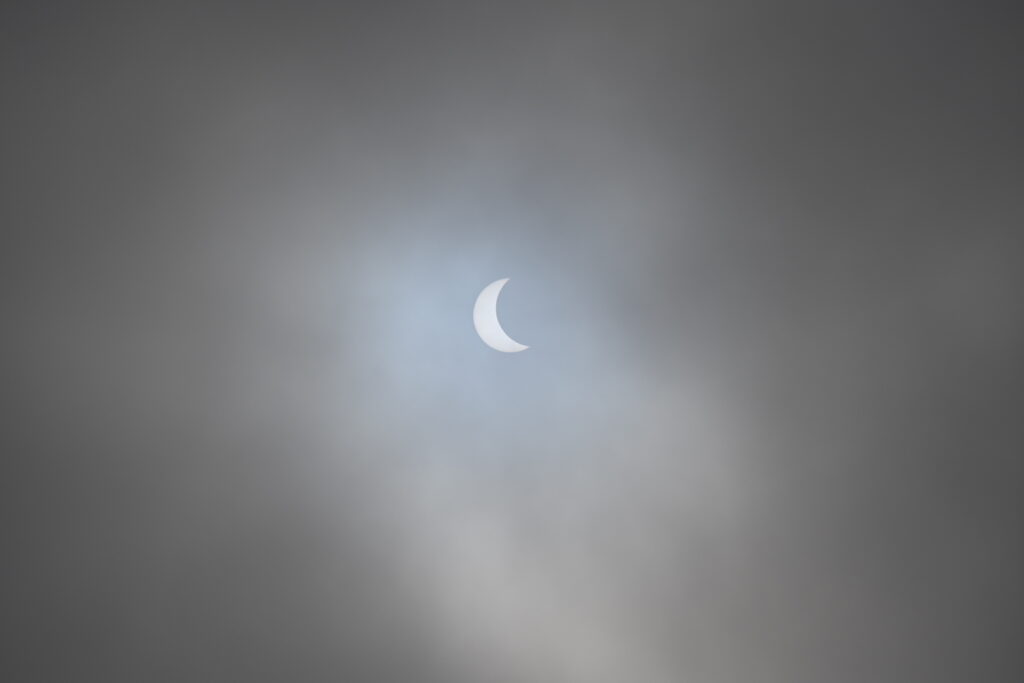
And another:
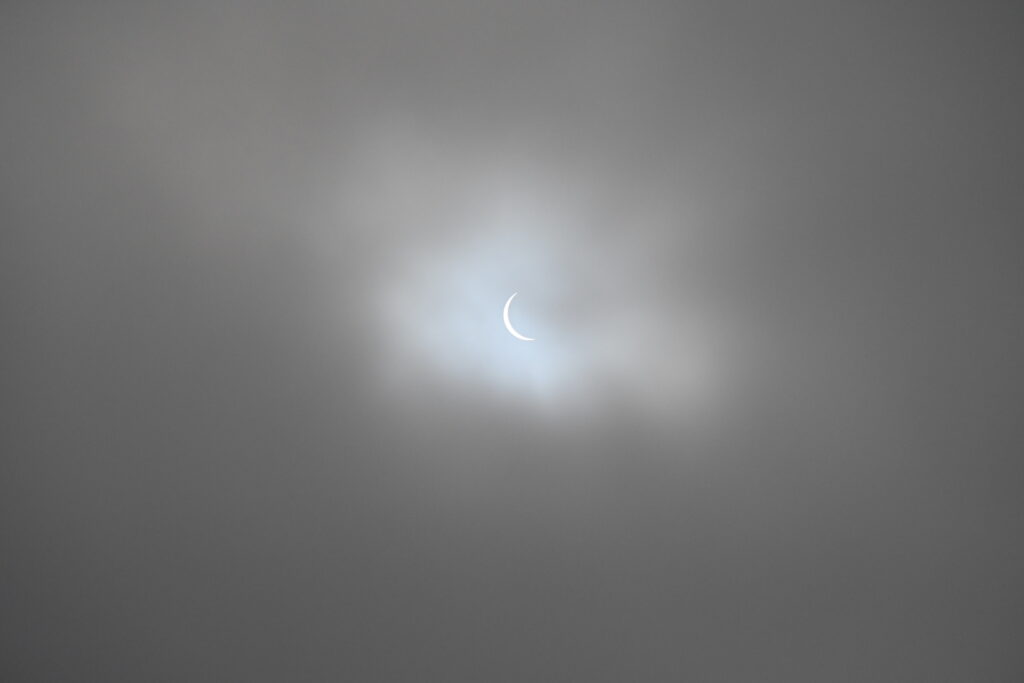
And another still:

There’s a festive atmosphere onboard, with a swell of “Ooooh” every time the eclipse is revealed, and a crash of “Ohhh” whenever it disappears again. The sun is so shrouded in cloud that you can just about look at it with the naked eye. It’s completely invisible whilst using my solar filter, so I take the chance of snapping a few shots without the filter on. (Don’t try this at home, kids.)
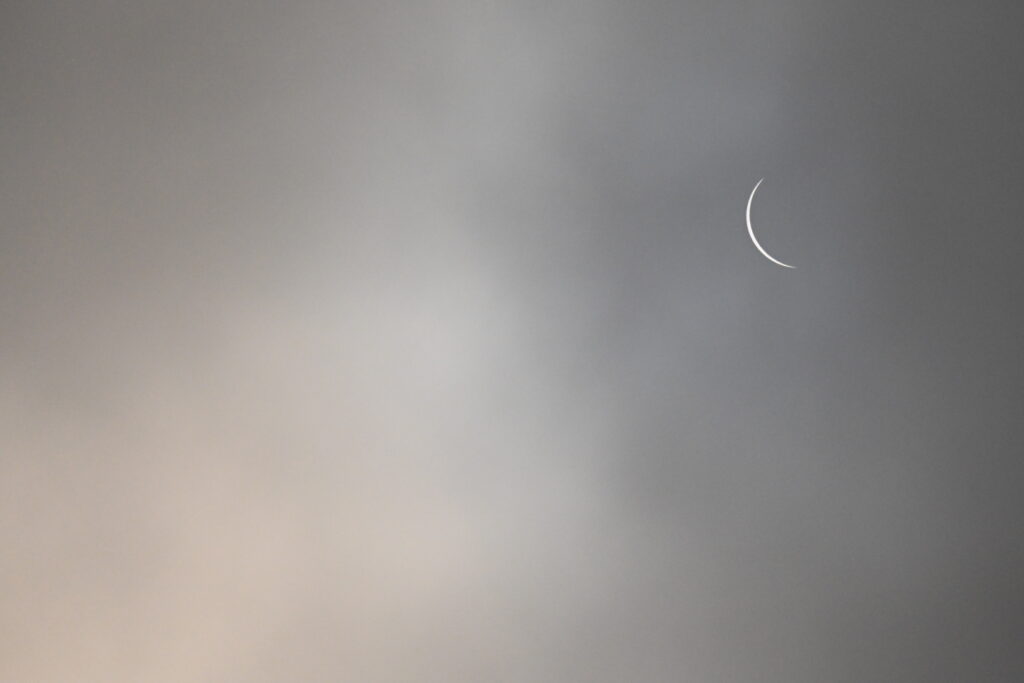
Thankfully the viewfinder in the Nikon Z7ii is digital, so I don’t have to worry about burning out my actual eyes – just the sensor on an expensive camera.
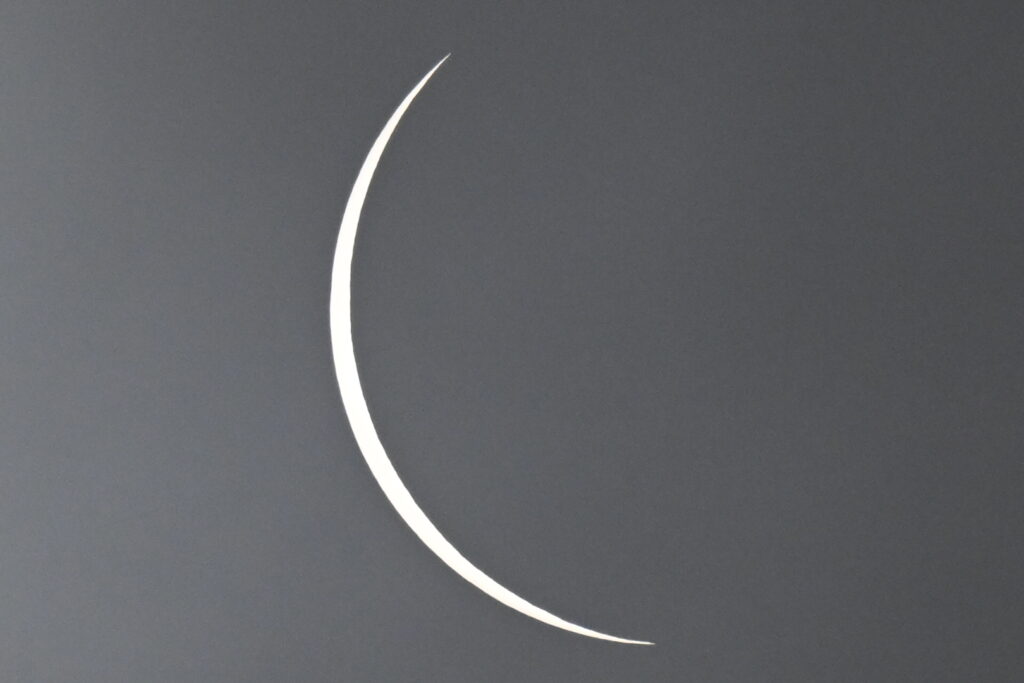
And it’s not long before totality reaches us, and temporary night envelops Le Lyrial.
I keep the camera in place just in case the eclipse reveals itself, but no such luck – though we are still fortunate to have the profound feeling of sudden darkness falling upon us in this remote Arctic region. At the edges of totality, a kind of pink ‘sunset’ emerges, catching the icebergs in an otherworldly glow. I wish I had a second camera to capture this, but it lasts just a moment.
Then the darkness lifts. Some guests are disappointed at missing a view of the ‘total’ eclipse, but we simply feel fortunate to have experienced the thrill of the chase and caught what we did of a remarkable astronomical event. And there’s no question that the captain and crew did everything possible to give us the best chance of seeing the eclipse.
We then head off for the evening’s recap so that we can learn of the plan for tomorrow. David shares some further details regarding the hunt for the eclipse – none of the various weather models agreed with where any particular gap was going to be, so they just had to do the best they could with the information available:
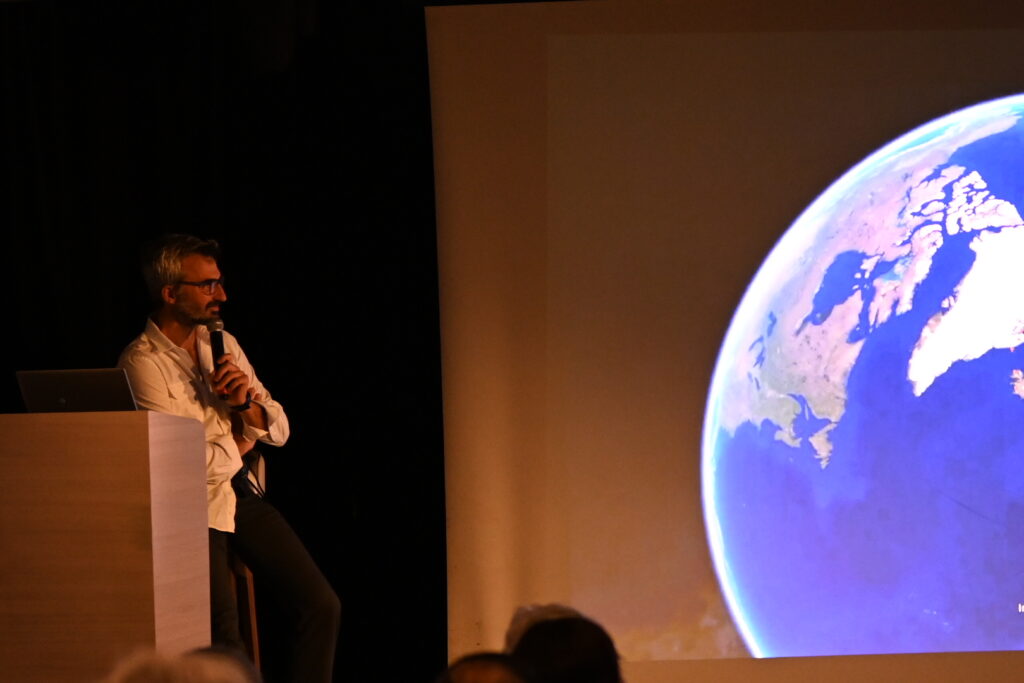
“You win this time, sun – but I’ll get you next time!”
We won’t have any off-ship activities tomorrow, but will instead do a ship’s cruise of the Dynjandi waterfall and then cruise the Westfjords area on the way out. This area is known for extensive whale activity, so we’re encouraged to keep watch from on deck.
David doesn’t particularly go into the reasoning behind the lack of stops tomorrow, but I expect there are a host of reasons – the swell is heavy, and we won’t want to have to boot it from Westfjords to Reykjavik to make up for lost time. We also may have needed to properly clear in with Icelandic authorities before beginning operations in the area. And we went much further out than expected in search of the eclipse.
We don’t mind the extra sea day. We were always going to lose one of the days to the hunt for the eclipse, and we have effectively traded a day in Iceland for a day in Greenland. That’s good deal, in our opinion.
We are also wrecked and need to pack, so we won’t complain. (Personally, I think the end of a cruise is the ideal time for a sea day – otherwise there’s simply too much to do.)
Off to dinner – quail and mashed potatoes from the buffet, and another spectacular dessert spread:
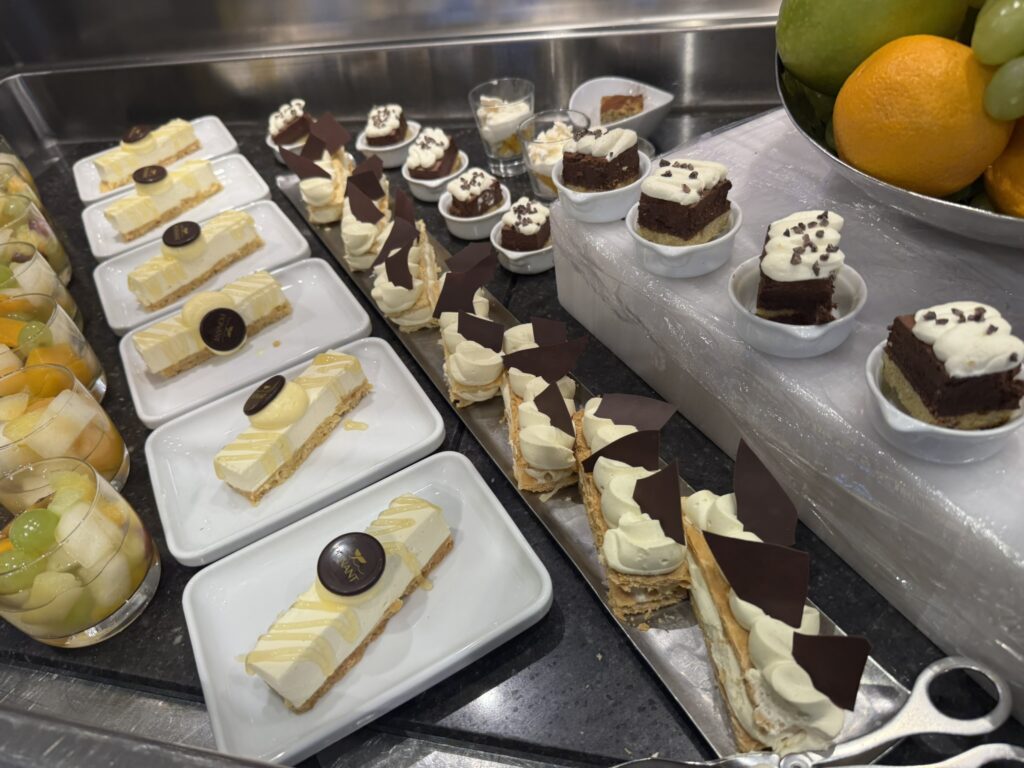
The chocolate squares are good, but the lemon cheesecake steals the show
Then it is most definitely time for bed, perchance for a moment of rest and respite before we are once more thrown into the travel vortex – though Mother Nature may yet have more surprises for us before the trip is through.