Today’s Daily Program:
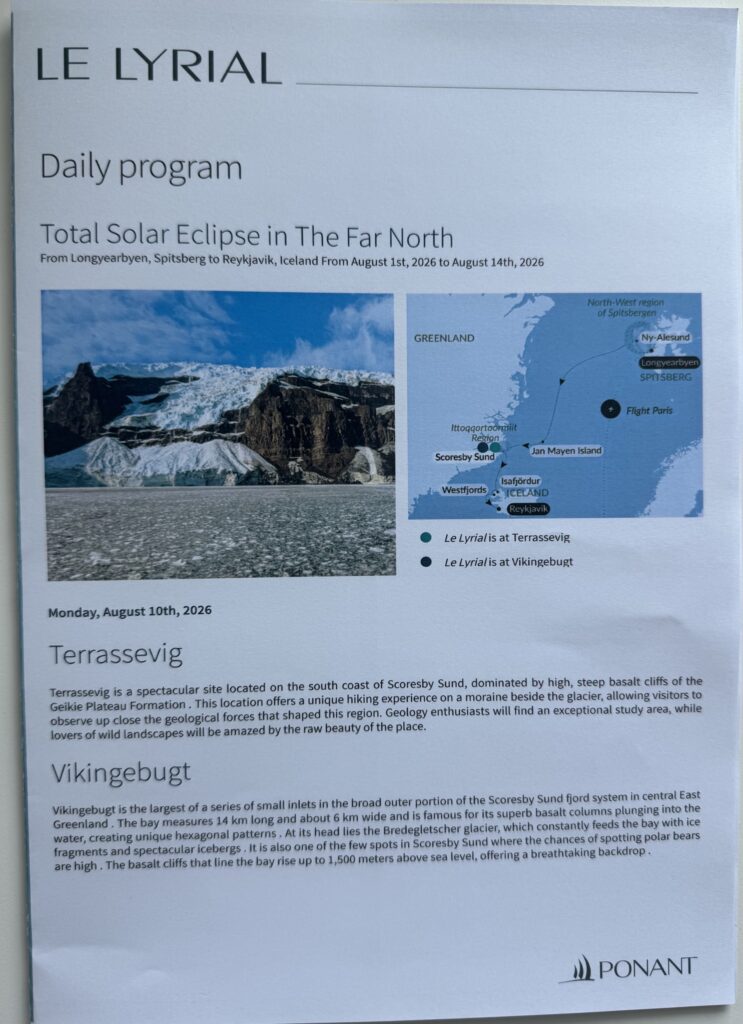
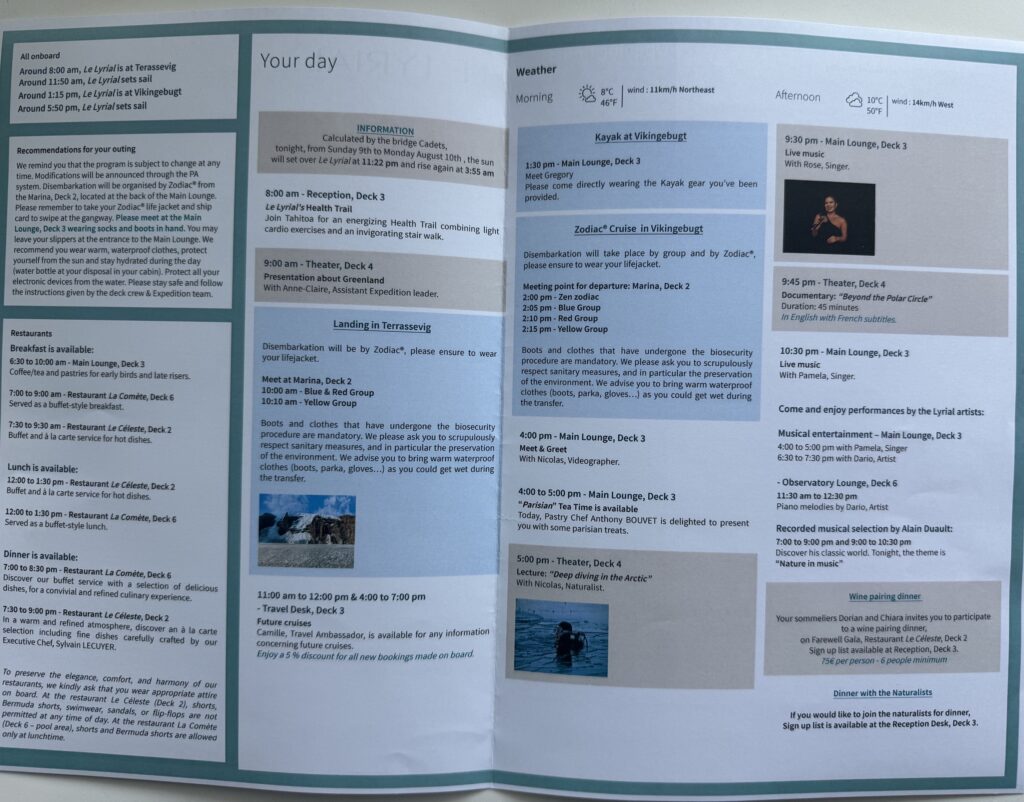
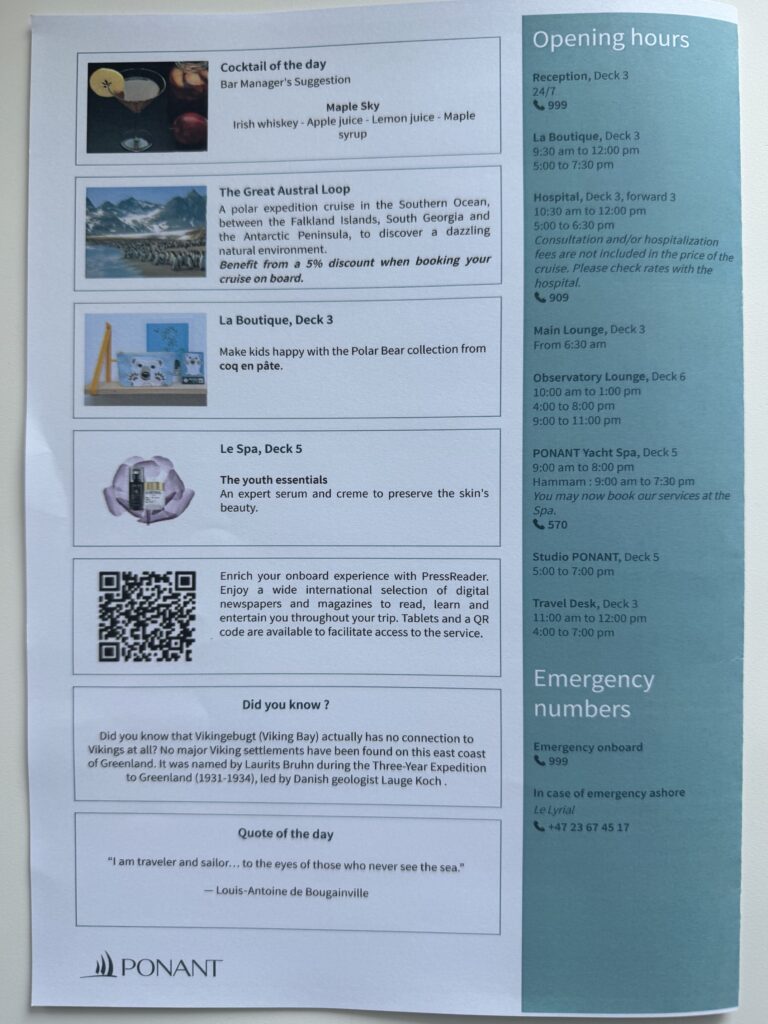
We awaken near Terrassevig, deep in Scoresby Sound, curious as to what Ponant can possibly add to an already-stellar expedition cruise. Greenland is known for its stunning glaciers, but we’ve already visited Samarinbreen in Svalbard. It’s going to be hard to top that.
Our zodiac cruise isn’t until 10 am, and there’s a brief hold-up as a local fishing vessel swings by to pick up a bit of extra water – and leaves with three loaves of baguette. No photos, but I will forever remember the man standing at the bow of his boat, pausing for a victory photo, a length of baguette clenched in each hand. Farewell, brave fisherman – bon chance.
We then board the zodiac only to discover that this is not – as we’d thought – a zodiac cruise, but instead a landing. There’s a beautiful waterfall here, and we’re going to hike up it. This is a reversal of the initial plan, which called for a zodiac cruise in the morning and a hike in the afternoon. But this is Expedition Territory, after all.

All onshore for the initial briefing. There will be guides stationed at regular intervals to help us along the route. Those who wish to stay closer to the waterfall can do so, with the reminder that they should get to higher ground in the event the glacier calves, as the resultant wave could easily sweep over the shore with devastating results.
We’re soon on our way – David will later tell us that the terrain here would rank as a ‘4’ on the difficulty scale for both incline and obstacles, with a ‘5’ requiring specialized equipment. There are large steps involved over uneven rocks, and sometimes we are using our hands to get a better grip. It’s not quite rock climbing, but it’s not far off.
Despite the harsh, rocky volcanic landscape there are carpets of Niviarsiaq – the national flower of Greenland, also known as ‘dwarf fireweed’ or ‘river beauty.’


I attempt a long-exposure shot of the waterfall, but it’s simply too bright to extend the shot for more than a fraction of a second.

Besides, we still have more climbing to do. We soon reach the top of the waterfall:

We carry on along the river, fording the shallows in sections:


The flowers are incredible. It’s almost like a meadow:

Until we reach as far as dare go, lest we make ourselves a tempting target for roving polar bears:

And then it’s time to head back:

With a few more long-exposure shots enroute:


But then it’s time to reboard the zodiac.
None of this was planned, of course. The expedition team had seen the river via Google Earth, but had no idea there was waterfall here. It was that discovery that prompted the sudden change in plans. (That change was reflected in the Daily Program, but not in the initial briefing – another reason why it’s important to always read the Daily Program or check the slow-to-load Ponant app.)
Back to the ship for lunch, and some time up in Observation. There has been some talk recently regarding the Trump-linked Greenland Energy shipping equipment for exploratory drilling without a permit, and we wonder if we might see Danish government ships in the area – but we haven’t yet.
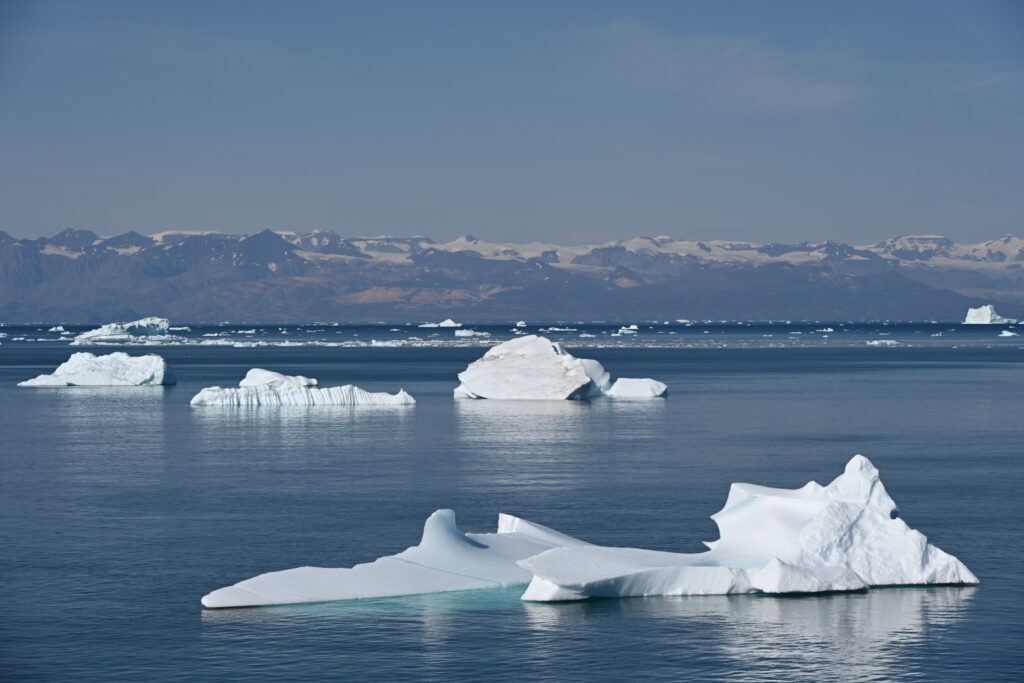
So far it’s nothing but icebergs:
Our departure time is pushed back, and then moved up again – another hallmark of life in Expedition Territory. (My wife is attempting to sign our son up for rock climbing lessons, which will be released at 4 pm ship’s time, adding another wrinkle to the process.)
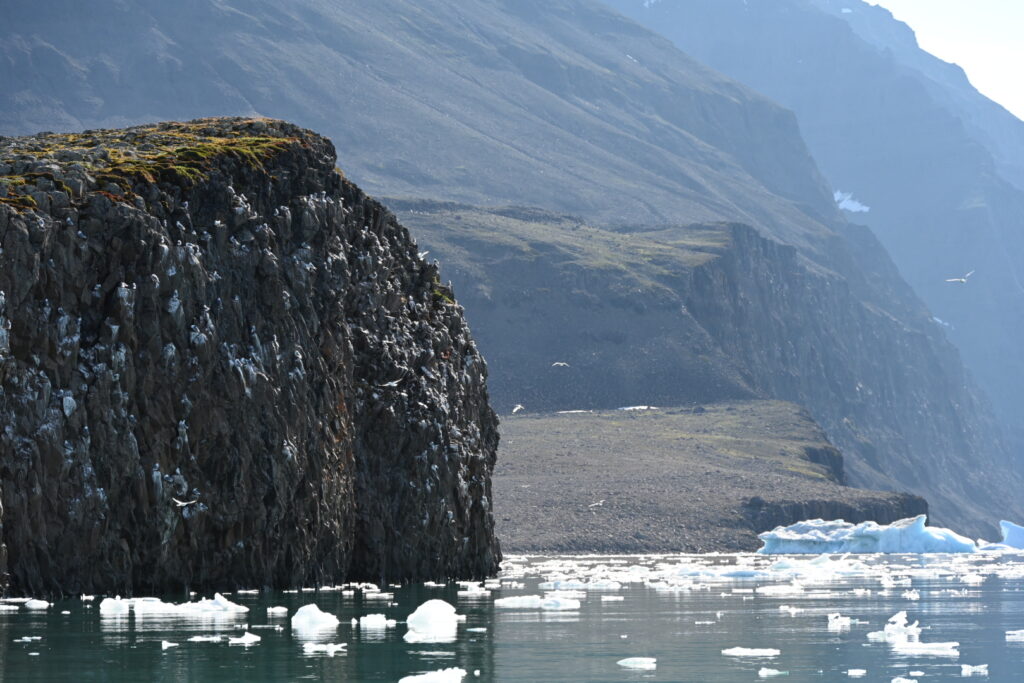
We soon board our zodiac and are underway. We start by visiting some interesting geography – some basalt columns, similar to those found on Giant’s Causeway:


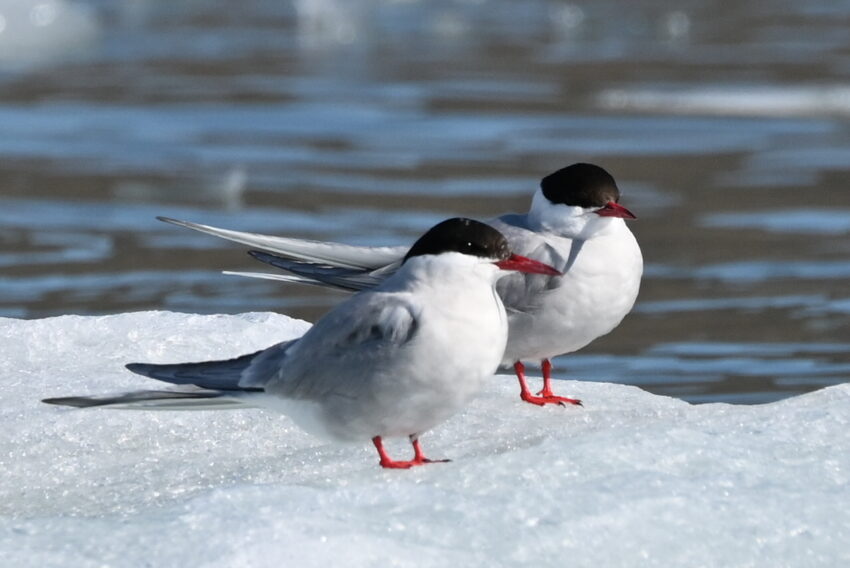
We are also fortunate enough to spot some arctic terns as they bob and fish in the water:

Terns can effectively hover in place. This – combined with their silhouette – has earned them the nickname, ‘the angels of the north’:

We even manage to catch one with a fish in its mouth:

And some atop an iceflow:

We cruise past some icebergs, and through the brash ice.


We realize that this will be our last time amidst the ice for some time. We do our best to live in the moment, rather than focus on the impending loss we’ll face once we start steaming toward Iceland.
Our guide cuts the engine, and we’re able to float for a time – just listening to the slosh of the ice in the water, and the bubbling all around us.
The kids get the chance to put a small piece of ice in their mouths, and feel the air bubbles on their tongues. Beyond the salty exterior, the glacier ice is fresh water and safe to drink.
We head to another island:

With more fascinating geology:

And where we encounter more terns:

As well as some kittiwakes on the other side:

The kayakers are finally getting their chance to go out – and they should have a pleasant paddle amidst the brash ice.
In the distance, an iceberg flips over to the other side:


Another reminder as to why it’s important to keep one’s distance.
Then our time out amidst the ice comes to an end, and we return to Le Lyrial:

Memories of the kissing chicken rocks of Halong Bay – minus the junk boats ramming each other for prime photo positioning
We celebrate a fantastic stint in Greenland with a glass of champagne out on the verandah, and then it’s time to head to Nicolas’ presentation on deep water polar diving:

It’s fascinating to learn that the first polar divers were ships’ carpenters on exploration voyages like the failed Franklin expedition. (Nicolas makes an aside to note that they were able to find the missing Franklin ships – Erebus and Terror – by asking the local Inuit community, who had kept the legend of the ships alive in their folklore.) Nicolas notes that the rebreather is in many ways less effective than a regular SCUBA apparatus, but that it does not release bubbles back to the surface – making it ideal for film work. Divers are often less expensive than submarines or robots when it comes to recording scientific information or obtaining footage.
It could take upwards of two hours to put on all the equipment needed for a polar dive, and they would often dive extremely deep – sometimes as deep as 120 metres. Decompression was an extended process, and they would sometimes need to stay at 6 metres for more than an hour and a half. Some of the divers would actually sleep at this depth, while Nicolas had a waterproof bag for his Gameboy so he could play Pokemon. He jokes, “You can read a book in the water, but just once.”
His first exposure to Ponant was when the Commandant Charcot crossed paths with them in Svalbard and asked them to give a lecture – which they agreed to do in exchange for access to hot showers. Their generator was non-functional, and they had not showered for fifteen days at that point. Nicolas actually lived in an underwater house for several days at a time when filming in French Polynesia. There’s a YouTube channel called Under the Pole that documents some of the work done by Nicolas’ former team.
We’re about to head to dinner when there’s an announcement over the ship’s speaker – based on the weather outlook for the day of the eclipse, it makes more sense for the ship to remain closer to Greenland. This means that Expedition Leader David and the captain have elected to stay in Greenland an extra day, so they’re planning out another two expedition activities for tomorrow. We already have 12 days scheduled in Iceland for after our cruise, so we’re quite happy to trade a day in Iceland for an extra day in Greenland.
Off to dinner, where I finally order the Ponant burger:
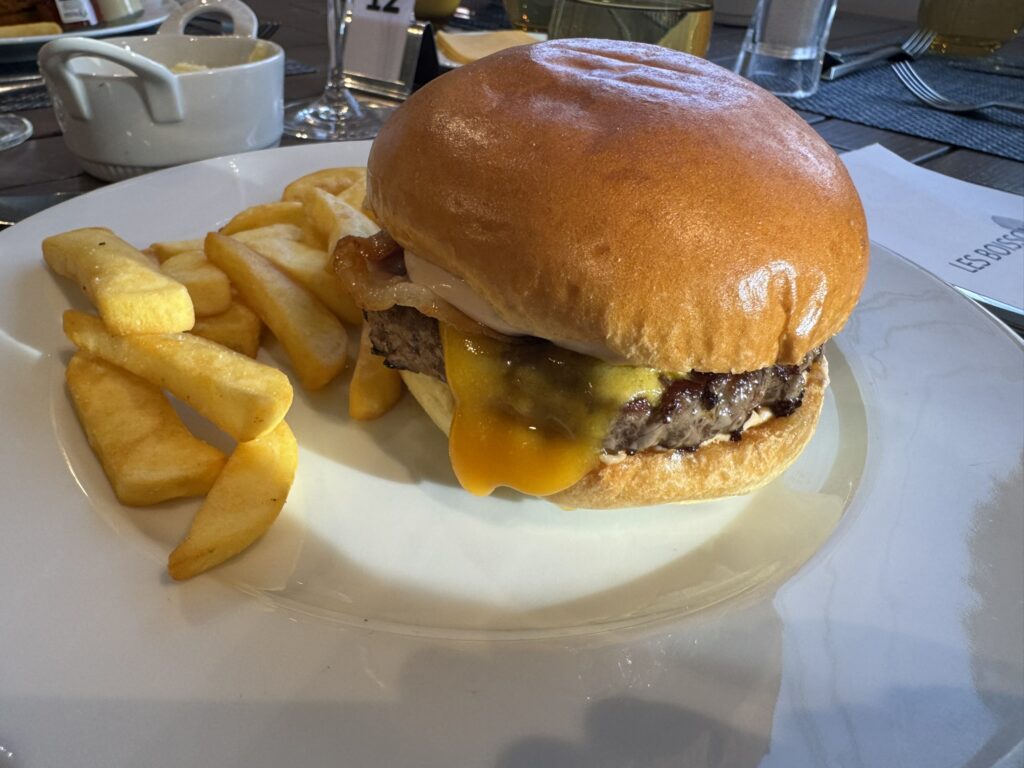
And it’s excellent – the best burger I’ve ever had on a cruise ship
Back to the room for a bit. The sun begins to dip toward the horizon, and I get a few shots of the pink-tinged icebergs in front of the rugged volcanic mountains:

We actually have five hours of semi-darkness tonight, which we intend to use to their fullest extent.
Tomorrow’s program arrives, and it reads like a high school paper whose author is desperate to pad out the length:
“The name Tulaajiip Kangersiva is the Greenlandic designation for the Barclay Bay area, reflecting local toponymy. This bay is located on the east coast of Greenland, in the King Christian IX Land region. It is a typical coastal area of East Greenland, characterized by a wild coastline and steep mountains plunging into the ocean. The bay stretches for about 14 km and is approximately 5 km wide.”
And you know what? We don’t mind one bit – we’re just here for the adventure, and we’re quite happy to head into tomorrow with no idea of what fate has in store for us.

Having spent with morning in Ha Long Bay with you, I agree that the icy kissing chickens are far superior. What a fabulous cruise you are enjoying. Thank you for taking me along. Good luck with the eclipse.
Thanks, Wendy! It was a great cruise – hard to believe we’re already off the ship, but they all seem to go so quickly. Another one for the books. Thanks so much for coming along for the ride, and hope our paths cross again sometime soon.
Have you ever seen the Columnar Basalt cliffs in Ontario? They are on the Canadian side of Lake Superior at Grotto Point, Lake Superior National Marine Conservation Area. Geologic features like this are on my travel itinerary checklists. And when eclipses fall near special geologic features that’s a bonus!
We haven’t been, but thanks very much for the recommendation! We’ve been neglectful of our own backyard, but plan to make up for that now that we can longer travel for the longer stints due to our eldest going into high school.